3D reconstruction — real scenes, rebuilt from an ordinary phone
One pipeline recovers where every camera stood and fits a dense field of oriented 3D Gaussians until it re-renders the scene. It does not care whether the subject is a house, a car or a living thing — only whether the capture saw it. Two capture routes appear below and they are not the same: the two house exteriors are solved from video frames alone, by photogrammetry, with no depth sensor involved; the interior, the quick phone captures and the pets use our iOS app and the phone's own LiDAR. Each example says plainly which it is, and what it is and is not.
Model · — gaussians Input · phone capture Runs · in-browser WebGL2Every splat is an oriented 3D Gaussian — position, colour, opacity and a covariance — solved so the set reproduces the input frames. Sorted back-to-front and alpha-blended live. No accuracy figure is quoted anywhere on this page: these are diagnostic reconstructions, not surveyed measurements.
Examples
One handheld exterior and one drone survey, solved from video alone, and one interior built from the phone's LiDAR.
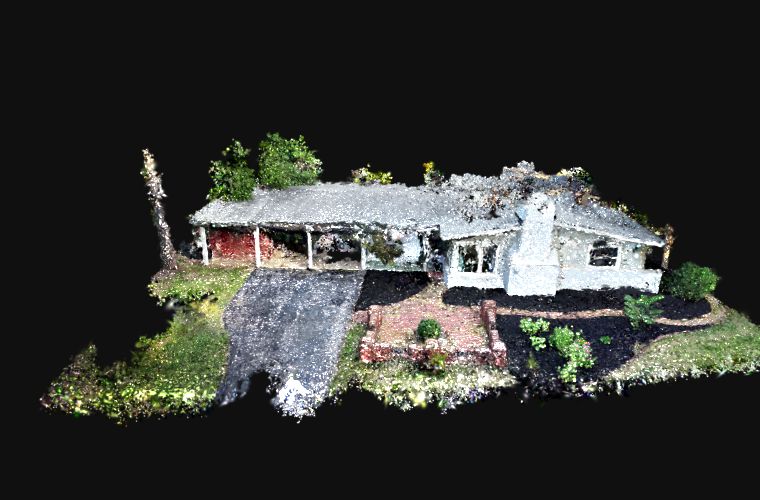
House exterior - garden and front
732,354 gaussiansA residential exterior walked with a phone. Every surface you see was solved from video frames alone: no drone, no measured control points, and no depth sensor - the phone recorded LiDAR alongside the video, but this model was trained without it.
House exterior - a second property
previewA second property, flown at walking height and merged into a single model.
House interior - guest room
1,346,246 pointsA bedroom walked once with an iPhone. Its walls, floor, ceiling and furniture are the phone's LiDAR depth fused into one surface and coloured from the video frames. Where the LiDAR left gaps, the surface was filled in from the frames and its surroundings, and floor no frame could see (under the bed) was completed in the carpet's pattern. About a fifth of the area is inferred rather than measured. One wall panel above the bed was removed and the wall behind it repainted from the wall around it. Shown as points sampled from that surface. The camera opens inside the room.
The same reconstruction core at object scale rather than building scale.
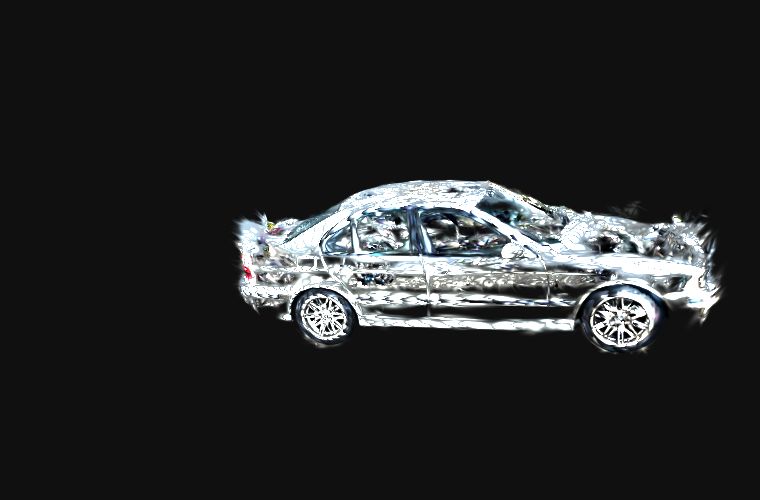
Passenger car
previewA vehicle solved exactly the way a building is. The method does not care about scale.
Second vehicle - inside and out
in progressA vehicle captured inside and out, so an interior volume comes with the shell.
Truck
in progressA moving subject is a different problem: 3D freezes it, 4D keeps the motion.
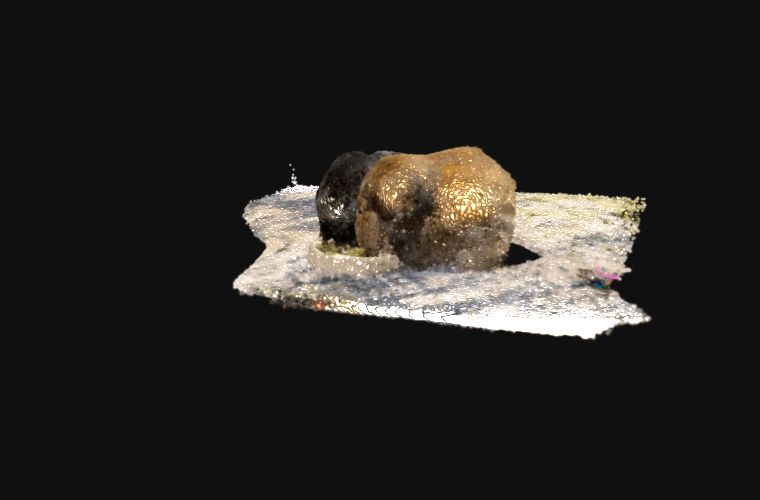
Pets - measured LiDAR capture
previewA living subject, measured rather than reconstructed.
Pet - photogrammetric model
in progressA moving animal frozen into a single static model.
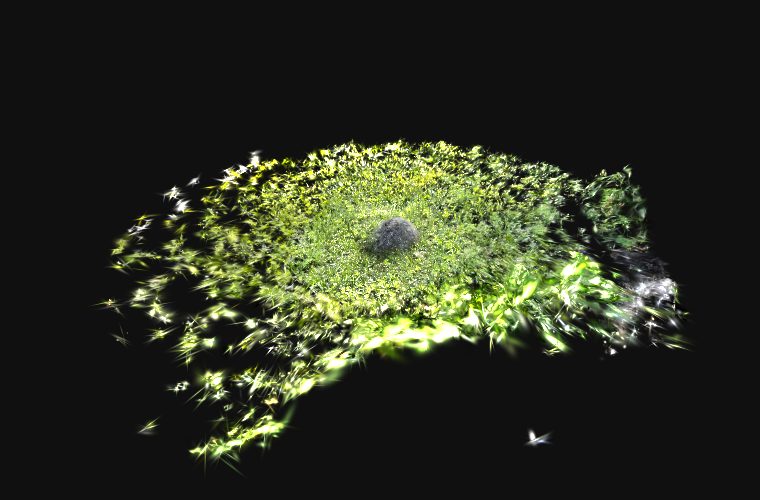
Pet - measured 4D playback
previewThe same animal over time. A million measured points across 1,308 frames, played back as motion rather than frozen into one static scene.
Captured by walking around the subject with our iOS app and reconstructed on the phone itself, in minutes, with no workstation in the loop. Unlike the buildings above, this route uses the phone's LiDAR alongside the camera.
Potted plant
400,000 pointsA single plant captured by walking around it with the phone - camera and LiDAR together - and reconstructed on the device itself rather than on a workstation.
Vehicle, walked around
217,932 pointsThe same on-device method at vehicle scale - one orbit of the subject with camera and LiDAR, no rig and no post-processing on a workstation.